Saturday, 26 August 2017

Our Students, Once More, Have Demostrated Our Culture Of Excellence

OUR STUDENTS, ONCE MORE, HAVE DEMONSTRATED OUR CULTURE OF EXCELLENCE

It is no longer news that University of Nigeria, Nsukka (UNN) is still the best in grooming excellent scholars, who can compete victoriously amongst their counterparts in Nigeria and in the world at large. This was demonstrated again, as our students recently added numerous medals to our gallery.


Our student, Mr. Chijioke Kizito Onah, is currently at United Kingdom as he emerged one of the six undergraduates selected alongside Masters and PhD students to participate in the 2017 Association of Commonwealth Universities (ACU) Summer School, holding at Bath SPA University, Scotland. The ACU Summer School, which is in its seventh year, is an opportunity for talented university students from around the Commonwealth to come together for an exciting week of expert lectures, group work, field trips, skills development and social events.

Mr. Onah, Chijioke Kizito, who has achieved this feat, is a final year (Combined Arts) student of the department of English and Literary Studies with a minor in History and International Studies. He is a seasoned literary winner, having made UNN proud as winner of several scholarships and writing competitions.

        Mr. Onah, Chijioke Kizito at Bath SPA University, Scotland


Furthermore, three of our students recently broke record in an essay contest organized by African Organization for Standardization (ARSO) in collaboration with Standards Organization of Nigeria (SON) for Nigerian undergraduates. Among all the higher institutions in Nigeria that participated in the contest, the 1st, 2nd and 3rd positions were all won by our students. They include:

Ota, Ama Chinonso, a 400 level student of the department of Zoology and Environmental Biology, UNN emerged the 1st prize winner,
Ogbaga, Sunday T., a 400 level student of the department of Public Administration and Local Government, UNN clinched the 2ndposition while
Christopher Mercy, a 500 level student of Law UNEC, took the 3rd position.
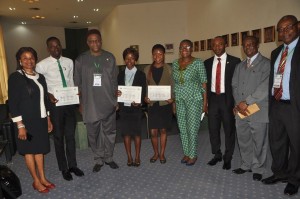
The students with Director General of SON and other dignitaries during the award ceremony at Abuja


Again, we are equally delighted to inform you that the first prize winner, Ota, Ama Chinonso, represented Nigeria at the Continental level of the competition, where she defeated other contestants to emerge the 3rd Continental winner. She was subsequently invited to Burkina-Faso where she was honored.

That is not all.  Just last month, 13th July, 2017 precisely, a similar feat was recorded. Two of our students clinched the 1st and third positions respectively in an essay competition organized for Nigerian undergraduates by Nigeria Higher Education Foundation (NHEF). They include:

Ignatius-Nwokolo, Chidi, a 500 level student of Medicine and Surgery
Agbom, Emmanuel, a 400 level of Pharmacy.
Moreover, Six other UNN students were also selected as 2017 NHEF scholars after keenly contested selection processes. They include:

Onah, Nicodemus, C. (300 level, Department of Electronic Engineering);
Nwikpo, Ogechi (300 level, Department of Mathematics);
Cyriacus, Ukamaka (300 level, Department of Economics);
Ejiofor, Ifechukwu 300 level, Department of Computer science)
Ogbuka, Chioma (recent graduate, Department of Law)
Uche, Osita James (recent graduate, Department of Law)

       The NHEF essay winners and Scholars at a training section in Lagos


In the same category of feat, few months back, our student, Odonoekuma Onyebuchi Ekuma, a final-year medical student of the University of Nigeria, Nsukka was also named the Star winner of the 2nd edition of the Etisalat-DigitalSENSE Students’ Essay Competition.

It is noteworthy to point out at this juncture that these students who have made us proud are members of the University of Nigeria Essayists Group. This is an association that comprises of national and international award-winning essayists and writers from both our UNEC and UNN campuses. The scholars have proudly represented the University and won prestigious essay competitions such as the Nigeria Communication Commission (NCC) essay competition, Chartered Institute of Personnel Management, Nigeria (CIPMN) annual essay competition, DigitalSense Africa essay competition, Nigeria Higher Education Foundation (NHEF) annual scholarship essay competition, Ships and Ports annual essay competition, National Association of Nigerian Students (NANS) essay competition, Women Aid Collective (WACOL) essay competition, Standard Organisation of Nigeria (SON) in collaboration with African Organisation for Standardisation (ARSO) continental essay competition, IRUL in collaboration with United Nations Population Fund worldwide youth essay competition, Gourmet French scholarship essay competition . . .to mention but a few.

The group was formed to mutually encourage art literature, share tips for winning academic contests; and to groom writers/essayists who will continue to represent University of Nigeria in national and international academic contests.

To the above named students, the university administration is using this medium to congratulate all of you once again. We are proud of you, and we’re equally urging you to keep it up

Friday, 25 August 2017

UNN Admission Information


UNIVERSITY OF NIGERIA, NSUKKA

OFFICE OF THE REGISTRAR


August 25, 2017


UNIVERSITY OF NIGERIA, NSUKKA (UNN) ADMISSION CUT-OFF MARK AND CONDUCT OF POST-UME SCREENING EXERCISE

FOR 2017/2018 ACADEMIC SESSION


This is to inform the general public that the cut-off mark for admission into the University of Nigeria, Nsukka (UNN) for 2017/2018 academic session is 200. Also, there will be a Post-UTME Aptitude Test/Screening Exercise.


Please continue to check our website for further information.


Chris C. Igbokwe, Esq.

Registrar

Tuesday, 15 August 2017

SSANU CHAOS: RANDOM BEATING OF UNN STAFFS AND STUDENTS TO STOP WORK!

Staffs and students of the University of Nigeria Nsukka working at the ICT department were attacked earlier today my members of SSANU. Many of them were left with injuries after receiving severe beating from the attackers for going to work instead of observing the ASUU strike. The attackers were reported to have arrived at the scene with sticks, wires, iron rods, etc. The victims were taken to the hospital to receive treatment and thereafter were treated to free lunch.

Friday, 14 July 2017

CBT Exam Batch For GS Courses From July 17th-19th


CBT Exam Batch For GS Courses From July 17th-19th

Kindly click on  DOWNLOAD for further details

Sunday, 9 July 2017

Men's skirts

Men's skirts

 Outside of Western cultures, men's clothing commonly includes skirts and skirt-like garments; however, in North America and much of Europe, the wearing of a skirt is today usually seen as typical for women and girls and not men and boys, the most notable exceptions being the cassock and the kilt. People have variously attempted to promote the wearing of skirts by men in Western culture and to do away with this gender distinction, albeit with limited general success and considerable cultural resistance.

A contemporary kilt
A group of upper-class Albanians
An Indian man wearing a veshti or mundu
A Sri Lankan man wearing a sarong
An illustration from between 1325-1335 showing an English man in a skirted garment
A saxophone player wearing a skirt


In Western cultures

Ancient times

Ancient Hebrew, Greek, and Roman men generally wore some form of tunic. Ancient Egyptian Pharaohs wore a wrap skirt known as a shendyt, which was similar to modern kilts, while the high priests wore a wrap skirt similar to a sarong.
Both the Anglo-Saxons and Normans wore skirted garments, as can be seen in the Bayeux Tapestry. These fashions continued well into the Middle Ages.

Decline

From the early Victorian period, there was a decline in the wearing of bright colours and luxurious fabrics by men, with a definite preference for sobriety of dress.[3][4][5] By the mid-20th century, orthodox Western male dress, especially business and semi-formal dress, was dominated by sober suits, plain shirts and ties.

Revival

In the 1960s, there was widespread reaction against the accepted North American and European conventions of male and female dress. This unisex fashion movement aimed to eliminate the sartorial differences between men and women. In practice, it usually meant that women would wear male dress, i.e., shirts and trousers. Men rarely went as far in the adoption of traditionally female dress modes. The furthest that most men went in the 1960s in this regard were velvet trousers, flowered or frilled shirts and ties, and long hair.[3]
In the 1970s, David Hall, a former research engineer at the Stanford Research Institute (SRI), actively promoted the use of skirts for men, appearing on both The Tonight Show Starring Johnny Carson and the Phil Donahue Show. In addition, he was featured in many articles at the time.[6] In his essay "Skirts for Men: the advantages and disadvantages of various forms of bodily covering", he opined that men should wear skirts for both symbolic and practical reasons. Symbolically, wearing skirts would allow men to take on desirable female characteristics. In practical terms, skirts, he suggested, do not chafe around the groin, and they are more suited to warm climates.
In the 1980s, a few male celebrities dressed in skirts, and fashion designers such as Jean-Paul Gaultier, Giorgio Armani, John Galliano, Kenzo, Rei Kawakubo, Marc Jacobs and Yohji Yamamoto tried to promote the idea of men wearing skirts, but the wearing of skirts by men remained firmly linked with ideas of effeminacy. Lead singer of Korn, Jonathan Davis, has been known to wear kilts at live shows and in music videos throughout his career of 18 years with that band. Guns N' Roses' singer, Axl Rose, was known to wear men's skirts during the Use Your Illusion period.
In 2008 in France, an association was created to help spur the revival of the skirt for men.[7] Hot weather has also encouraged use. In June 2013, Swedish train drivers won the right to wear skirts in the summer when their cabins can reach 35 °C (95 °F),[8] whilst in July 2013, parents supported boys wearing skirts at Gowerton Comprehensive School in Wales.[9]

Metropolitan Museum of Art exhibition

In 2003, the Metropolitan Museum of Art displayed an exhibition, organized by Andrew Bolton and Harold Koda of the Museum's Costume Institute and sponsored by Gaultier, entitled Bravehearts: Men in Skirts.[10] The idea of the exhibition was to explore how various groups and individuals (from hippies through pop stars to fashion designers) have promoted the idea of men wearing skirts as "the future of menswear". It displayed men's skirts on mannequins, as if in the window of a department store, in several historical and cross-cultural contexts.[11]
The exhibition display pointed out the lack of a "natural link" between an item of clothing and the masculinity or femininity of the wearer, mentioning the kilt as "one of the most potent, versatile, and enduring skirt forms often looked upon by fashion designers as a symbol of a natural, uninhibited, masculinity". It pointed out that fashion designers and male skirt-wearers employ the wearing of skirts for three purposes: to transgress conventional moral and social codes, to redefine the ideal of masculinity, and to inject novelty into male fashion. It linked the wearing of men's skirts to youth movements and countercultural movements such as punk, grunge, and glam rock and to pop-music icons such as Boy George, Miyavi and Adrian Young.[11] Many male musicians have worn skirts and kilts both on and off stage. The wearing of skirts by men is also found in the goth subculture.
Elizabeth Ellsworth, a professor of media studies,[12] eavesdropped on several visitors to the exhibition, noting that because of the exhibition's placement in a self-contained space accessed by a staircase at the far end of the museum's first floor, the visitors were primarily self-selected as those who would be intrigued enough by such an idea in the first place to actually seek it out. According to her report, the reactions were wide-ranging, from the number of women who teased their male companions about whether they would ever consider wearing skirts (to which several men responded that they would) to the man who said, "A caftan after a shower or in the gym? Can you imagine? 'Excuse me! Coming through!'". An adolescent girl rejected in disgust the notion that skirts were similar to the wide pants worn by hip-hop artists. Two elderly women called the idea "utterly ridiculous". One man, reading the exhibition's presentation on the subject of male skirt-wearing in cultures other than those in North America and Europe, observed, "God! Three quarters of the world's population [wear skirts]!"[11]
The exhibition itself attempted to provoke visitors into considering how, historically, male-dress codes have come to this point and whether in fact a trend towards the wearing of skirts by men in the future actually exists. It attempted to raise challenging questions of how a simple item of dress connotes (in Ellsworth's words) "huge ramifications in meanings, behaviours, everyday life, senses of self and others, and configurations of insider and outsider".[11]

Contemporary styles

The wearing of skirts, kilts, or similar garments on an everyday basis by men in Western cultures is an extremely small minority.[citation needed] One manufacturer of contemporary kilt styles claims to sell over 12,000 such garments annually,[13] resulting in over $2 million annually worth of sales, and has appeared at a major fashion show.[14] According to a CNN correspondent: "At Seattle's Fremont Market, men are often seen sporting the Utilikilt." [15] In 2003, US News said that "... the Seattle-made utilikilt, a rugged, everyday riff on traditional Scottish garb, has leapt from idea to over 10,000 sold in just three years, via the Web and word of mouth alone."[16] "They've become a common sight around Seattle, especially in funkier neighbourhoods and at the city's many alternative cultural events. They often are worn with chunky black boots," writes AP reporter Anne Kim.[17] "I actually see more people wearing kilts in Seattle than I did when I lived in Scotland," one purchaser remarked in 2003.[18]
In addition, since the mid-1990s, a number of clothing companies have been established to sell skirts specifically designed for men. These include Macabi Skirt in the 1990s, Menintime in 1999 and Midas Clothing in 2002.[19]
In 2010, the fashion chain H&M featured skirts for men in its lookbook.[20]

Wicca and neo-paganism

In Wicca and neopaganism, especially in the United States, men (just as women) are encouraged to question their traditional gender roles. Amongst other things, this involves the wearing of robes at festivals and sabbat celebrations as ritual clothing (which Eilers equates to the "church clothes" worn by Christians on Sundays).[21][22] Some denominations (called 'traditions') of Wicca even encourage their members to include robes, tunics, cloaks, and other such garments in their day-to-day wardrobes.

In non-Western cultures

Outside of Western cultures, male clothing includes skirts and skirt-like garments.[23] One common form is a single sheet of fabric folded and wrapped around the waist, such as the dhoti/veshti or lungi in India, and sarong in South and Southeast Asia, and Sri Lanka. There are different varieties and names of sarong depending on whether the ends are sewn together or simply tied. There is a difference in the way a dhoti and lungi is worn. While a lungi is more like a wrap around, wearing the dhoti involves the creation of pleats by folding it. A dhoti also passes between the legs making it more like a folded loose trouser rather than a skirt. In Sub-Saharan Africa, sarong-like garments sometimes worn by men are known as kanga (or khanga), kitenge (or chitenje), kikoy, and lappa.[24] In Madagascar they are known as lamba.
The Samoan Lavalava is a wraparound "skirt". These are worn by men, women and children. The women's lavalava pattern usually have either traditional symbols and/or a flower (frangipani) pattern. The men's lavalava have only traditional symbols.
In Sikhism, a faith that originated in the Punjab, there is a traditional dress which is worn by both men and women, called a 'baana' or 'chola'. This dress has a skirted bottom and is worn over long white undershorts. It was traditionally worn in battle by Sikh warriors as it allowed free movement and remains a part of the traditional Sikh dress and identity.
Some long robes also resemble a skirt or dress, including the Middle Eastern and North African caftan and djellaba.
Other similar garments worn by men around the world include the Greek and Balkan fustanella (a short flared cotton skirt), the Pacific lava-lava (similar to a sarong), the Fijian sulu vakataga,[25] some forms of Japanese hakama and the Bhutanese gho.
Skirts that are called qun(裙) or chang(裳) in Chinese were also worn by Chinese men in ancient times.

In popular culture

One notable example of men wearing skirts in fiction is in early episodes of the science fiction TV program Star Trek: The Next Generation. The uniforms worn in the first and second season included a variant consisting of a short sleeved top, with attached skirt. This variant was seen worn by both male and female crew members. The book The Art of Star Trek explained that "the skirt design for men 'skant' was a logical development, given the total equality of the sexes presumed to exist in the 24th century."[26] However, perhaps reflecting the expectations of the audience, the "skant" was dropped by the third season of the show.

Dance

In some Western dance cultures, men commonly wear skirts and kilts. These include a broad range of professional dance productions where they may be worn to improve the artistic effect of the choreography,[27] a style known as contra dance, where they are worn partly for ventilation and partly for the swirling movement, gay line dancing clubs where kilts are often worn,[28] and revellers in Scottish nightclubs where they are worn for ventilation and to express cultural identity.


Victor Ebubechukwu: VIVA NAIJA!

Victor Ebubechukwu: VIVA NAIJA!: A Russian saw me in my office and said, "Where are you from?" , I said am from the greatest country in the world. He looked at me...

Wednesday, 5 July 2017

Kristen Stewart Wears An Item Of Clothing That Defies Description

Kristen Stewart Wears An Item Of Clothing That Defies Description

It’s an interesting look, to say the least.

Over the past few years, Kristen Stewart has morphed into a daring fashion darling. Her recent look at the Chanel Haute Couture show on Tuesday was no exception.  
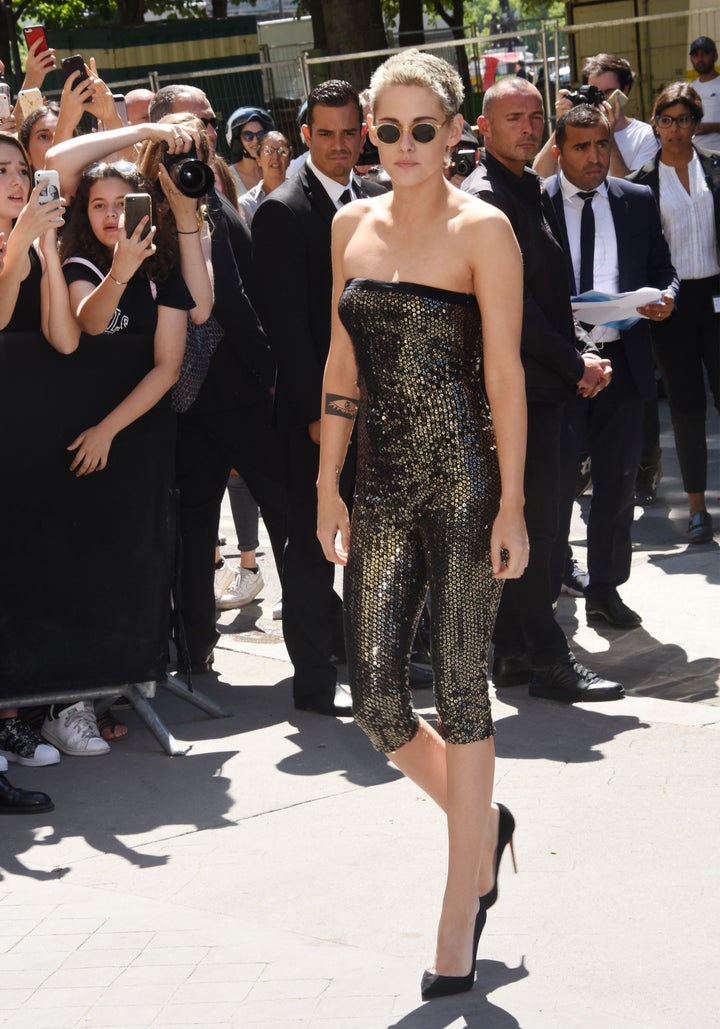
At the show, the actress modeled a look that nearly defies description ― but we’ll try. She wore a strapless, sequined jumpsuit that cut off at the kneecaps, paired with black Christian Louboutin heels. 
It’s quite the outfit:

Kristen Stewart attends the ‘Chanel’ show during Paris Fashion Week on July 4, 2017 in Paris, France.

 
Just another Tuesday look for KStew. 

Later on in the night, Stewart again turned heads at a launch party for Chanel’s new perfume, called “Gabrielle.”
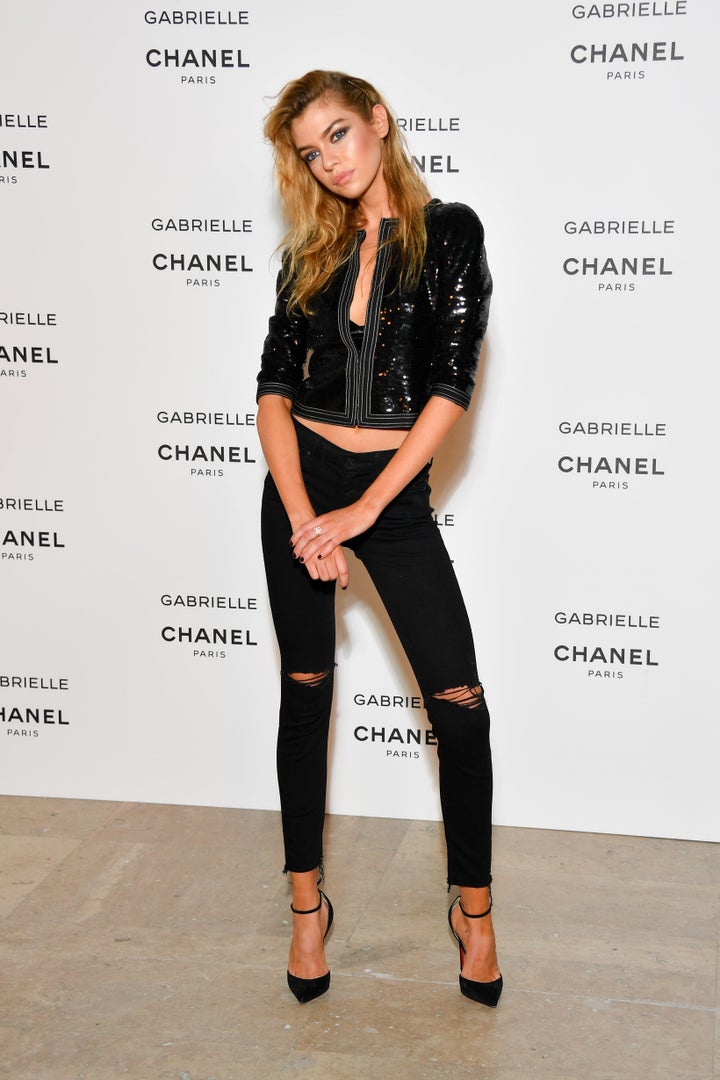
She wore a short, sequined minidress with long sleeves and yet another pair of Louboutin heels. Stewart’s blonde buzzcut, which she chopped back in March, paired perfectly with her smoky eyes. 
The actress looked every inch the model herself:
 
Stunning.  

 
 Kristen Stewart attends the launch party for Chanel’s new perfume ‘Gabrielle’ as part of Paris Fashion Week on July 4 in Paris, France.

The actress attended the show alongside her rumored girlfriend, Victoria’s Secret Angel Stella Maxwell. Earlier in the day, Maxwell walked in Ulyana Sergeenko’s haute couture show for Fall/Winter 2017-2018.


Maxwell went rocker chic for the launch party.

Hopefully we see more of this “haute” couple on the red carpet this week. 

To get more updates from my Blog, simply follow me up!


This DOJ Letter May Be More Alarming Than Trump Commission’s Request For Voter Data

This DOJ Letter May Be More Alarming Than Trump Commission’s Request For Voter Data

“I really worry that at the end of the day there’s gonna be a lot of noise about this Kobach-Pence commission and people will miss the enforcement efforts of DOJ.”


Former Department of Justice officials and voting advocates are seriously alarmed over a DOJ letter sent to states last week that they say could signal a forthcoming effort to kick people off voter rolls. This comes as national attention focuses on several states blocking a request for voter information from President Donald Trump’s commission to investigate voting fraud, which does occur, but is not a widespread problem.
The DOJ sent the letter to 44 states last Wednesday, the same day the Presidential Advisory Commission on Election Integrity sent a letter controversially requesting personal voter information. The DOJ letter requests that election officials respond by detailing their compliance with a section of the National Voter Registration Act of 1993 (NVRA), which covers 44 states and was enacted to help people register to vote, but also specifies when voters may be kicked off the rolls. 
Several experts said it’s difficult not to see the DOJ letter in connection with the commission’s letter as part of a multipronged effort to restrict voting rights. 
Former Justice Department officials say that while there’s nothing notable about seeking information about compliance with the NVRA, it is unusual for the department to send out such a broad inquiry to so many states seeking information. Such a wide probe could signal the department is broadly fishing for cases of non-compliance to bring suits aimed at purging the voter rolls.
“These two letters, sent on the same day, are highly suspect, and seem to confirm that the Trump administration is laying the groundwork to suppress the right to vote,” said Vanita Gupta, the CEO of the Leadership Conference on Civil and Human Rights and former head of DOJ’s civil rights division under President Barack Obama. “It is not normal for the Department of Justice to ask for voting data from all states covered by the National Voter Registration Act. It’s likely that this is instead the beginning of an effort to force unwarranted voter purges.”
These two letters, sent on the same day, are highly suspect, and seem to confirm that the Trump administration is laying the groundwork to suppress the right to vote. Vanita Gupta, head of DOJ’s civil rights division under President Barack Obama.
“If this went to any individual states, I don’t think anybody would’ve blinked twice,” said Justin Levitt, a professor at Loyola Law School who served as deputy assistant attorney general in the civil rights division in the Obama administration. The letter asked for public information that was uncontroversial, he added, but what made the letter “really weird” was that it was sent out to so many states.
“The Department of Justice does investigations all the time, but those are usually based on individualized predicates to believe that there’s a problem in a given area, in a given jurisdiction. And I’m not aware of a similar letter being sent to blanket jurisdictions across the country,” he said.
The NVRA requires states to “conduct a general program that makes a reasonable effort to remove the names of ineligible voters from the official lists.” If a state wants to act to remove a voter from its rolls, it must first send a broad, nondiscriminatory solicitation seeking a confirmation of address to those registered. If a person fails to respond, they can only be removed from the rolls if they don’t vote in the next two consecutive federal elections.
In the past, voting rights groups have used the legislation as a powerful tool to try to prevent states from kicking eligible voters off their rolls. The Supreme Court will consider a case next term dealing with whether a voter removal process used in Ohio is violating the NVRA.
The DOJ letter asks the states covered by the NVRA to provide information on the processes they use to remove people from the voting lists and the people authorized to implement them. It also asks for data from recent years on the number of voters removed from the voting rolls and the reasons they were removed.
“When you see DOJ send a bunch of letters like this requesting information about compliance with the law, that’s usually a sign that they’re kicking an enforcement campaign into gear,” Sam Bagenstos, who served as the principal deputy assistant attorney general for civil rights from 2009 until 2011. “It looks like what they’re doing is they’re laying the groundwork to file lawsuits against states that, in their view, aren’t kicking enough people off of the rolls.”
“It looks like what they’re doing is they’re laying the groundwork to file lawsuits against states that, in their view, aren’t kicking enough people off of the rolls.” Sam Bagenstos, former principal deputy assistant attorney general for civil rights
Devin O’Malley, a Justice Department spokesman, said the department’s review of list maintenance procedures hadn’t been done in many years.
“The Department of Justice is committed to free and fair elections for all Americans. Congress enacted the NVRA’s list-maintenance provisions specifically to advance that goal. The Department had not conducted a review of state and local list-maintenance activities under the NVRA for many years,” he said in a statement. “The Department looks forward to working with state and local election officials to facilitate appropriate list-maintenance activities toward our common goal of free and fair elections for all voters.”
A DOJ official also said the department had not coordinated with the separate election integrity commission.
But Bagenstos said he was skeptical the two efforts weren’t related and were part of a multifaceted approach by the Trump administration to make voting more difficult.
“What an amazing coincidence that these letters went out on the same day. This administration is, without even knowing it, doing parallel efforts to try to trim the voting roll. I don’t buy it,” he said. He added that the voter fraud commission led by Vice President Mike Pence and Kansas Secretary of State Kris Kobach was trying to create a nationwide database of voter registration that would paint a picture of potential voter fraud that could then be used to justify more restrictive voting laws.
David Becker, the executive director of the Center for Election Innovation and a former DOJ lawyer, agrees.
“In the quarter-century since passage of the NVRA, of which I spent seven years as a DOJ lawyer enforcing the NVRA, among other laws, I do not know of the DOJ conducting any other broad-based fishing expedition into list maintenance compliance, whether during Democratic or Republican administrations,” he wrote in a Thursday op-ed. Becker also noted it was strange the DOJ letter only focused on voter list maintenance procedures and did not want to examine compliance with parts of the law aimed at making it easier to vote. 

Allegra Chapman, director of voting and elections at nonprofit group Common Cause, said she found it striking the DOJ was uninterested in the aspect of the law that provided voter registration opportunities at public assistance agencies. 
“To me, that indicates this agency just has zero interest in ensuring the rights of poor Americans too and ensuring that, you know, people across the income divide are equally being given the registration services that they’re entitled to under federal law,” she said in an interview.
While Bagenstos said he was alarmed by both the Kobach and DOJ requests, he believed the department could be a much more potent tool in curbing access to the ballot box.
“On Kris Kobach’s work on this commission, they’re going to get a lot of push-back, they’ve already gotten some pushback from states. It’s all been sort of ham-handed,” he said. “They don’t really have staff, so that’s all really amateurish and it might not go anywhere. But the folks at DOJ know what they’re doing and I really worry that at the end of the day there’s gonna be a lot of noise about this Kobach-Pence commission and people will miss the enforcement efforts of DOJ.”
“DOJ, at the end of the day, is more likely to be successful as a tool in this process than is this commission, so that’s why I worry more about them,” he said.
Read the DOJ letter below:


Monday, 3 July 2017

Book Review: Baffled By Love


Book Review: Baffled By Love By Laurie Kahn
Reviewed by Claire Nana
~ 3 min read


Love is what everyone wants. And yet when those who are supposed to love us do just the opposite, the effects ripple throughout our lives, in both our relationships with others and our relationships with ourselves.

In Baffled By Love: Stories of the lasting Impact of Trauma Inflicted by Loved Ones, author Laurie Kahn dives deep into the lives of the many who have been traumatized, confused, and terrified by love. And ultimately, healed by it too.

“Even gifted clinicians quickly discover that what they learned in school does not suffice in practice,” writes Laurie Kahn, who is a pioneer in the field of trauma treatment. Trauma goes beyond what many can imagine, shattering core beliefs and assumptions about the world, people around us, ourselves and especially of love itself.

Trauma simply leaves us unraveled, like Kristi, who we meet in the first section of Kahn’s book.

Kristi is a young mother of three who finds herself overwhelmed and unable to face her children. After driving herself to the hospital one morning, Kristi discovers something: she likes the people in the hospital because they are real and honest, and no one is hiding anything. Growing up with an abusive father and a mother who turned a blind eye, Kristi had never before felt cared for.

“Allowing someone to care about her would be like choosing to play in traffic with a truck heading right toward her,” Kahn writes of Kristi’s experience.

Betrayals can be soul-crushing, and can leave us wondering if relationships can ever be a source of soothing. Because love has been interlocked with pain and hurt, therapy is a source of fear, not comfort for those like Kristi. And yet, while the challenge for her is to tolerate the therapeutic relationship, the challenge for the therapist is to be tolerant of her resistance to closeness and soothing.

Betrayal trauma – the term first coined by Jennifer Freyd for trauma resulting from betrayal – can also leave us blind. In what Freyd calls, “betrayal blindness,” our ability to recognize abuse, or the extent of the harm being done is taken over by our need to maintain our relationship with our caretaker.

“Betrayal blindness is a way of not knowing that shields a child from an unbearable conflict,” writes Kahn.

Much of the reason betrayal blindness affects us so strongly is because, unlike our capacity to detect injustices, detecting betrayal threatens our innate desire to be loved, or at least to maintain the image that we are lovable.

We can dissociate, developing what is called, “traumatic amnesia” as a way to simply avoid seeing what is so painful and emotionally overwhelming. We can also experience a dual awareness, sort of a knowing and not knowing, remembering and not remembering, as a way to split off that part of ourselves that is painful, and keep it out of reach.

And betrayal blindness distorts a child’s ability to accurately perceive danger in relationships, which makes them more vulnerable to abuse by partners and lovers as adults. Kahn writes, “One of the cruelest truths about childhood trauma is the way it revisits its victims when they adults. People who are victimized as children are more likely to be victims of domestic violence or to be sexually assaulted as adults.”

When trauma is not healed, it remains out of our cognitive reach, and outside of our awareness, driving us to recreate situations that are familiar, although again traumatizing. Yet sometimes these conditions can happen in therapy.

Kahn tells the story of Elizabeth, a woman who suffered sexual abuse by her father at a young age. After making considerable progress in therapy, Kahn asks Elizabeth if she could include parts of her story – with her identity protected – in an upcoming journal article. Elizabeth responds that she feels as if she has to say yes, because saying no would jeopardize her relationship with Kahn, and yet saying yes also means that she will go home and hurt herself.

Kahn tells her that it is her choice, although she will be disappointed if she says no. When Elizabeth reacts very strongly, stating that she “doesn’t know if she can continue in therapy, and that her past is now off limits for discussion,” Kahn realizes that they are in a therapeutic reenactment of the excruciating bind she felt as a child. “She wanted to please her perpetrator, the person she was dependent on and who was supposed to love and protect her, but when she pleased him, she felt complicit in her abuse,” she writes.

Later, when Kahn and Elizabeth are able to repair the relationship and discuss how betrayed Elizabeth felt by Kahn, Elizabeth tells her, “I never knew about the kind of relationships where someone really cares about you, where you can work through a conflict without destroying each other…I don’t think I will trust anyone until we have our first fight and successfully work it through.”

Filled with touching stories, poignant moments, and brilliant therapeutic insights, 
Baffled By Love, should be required reading for any clinician – new or seasoned.

To get more, visit https://psychcentral.com/lib/book-review-baffled-by-love/

OMG! Former Governor Of Yobe State, Bukar Abbar Ibrahim Caught Having Sex With 3 Ladies (Photos)


A former Governor of Yobe state and current senator, Bukar Abbar Ibrahim has allegedly been caught having sex with three ladies, according to Sahara Reporters.


The post OMG! Former Governor Of Yobe State, Bukar Abbar Ibrahim Caught Having Sex With 3 Ladies (Photos) appeared first on Ngyab

Sunday, 2 July 2017

VICTOR GLORIOUS BLOG: Approved Postgraduate Programmes Advert For 2017/2...

VICTOR GLORIOUS BLOG: Approved Postgraduate Programmes Advert For 2017/2...: UNIVERSITY OF NIGERIA, NSUKKA SCHOOL OF POSTGRADUATE STUDIES  POSTGRADUATE PROGRAMMES ADVERT 2017/2018 The University of Nigeria, ...

Approved Postgraduate Programmes Advert For 2017/2018

UNIVERSITY OF NIGERIA, NSUKKA

SCHOOL OF POSTGRADUATE STUDIES

 POSTGRADUATE PROGRAMMES ADVERT 2017/2018

The University of Nigeria, Nsukka invites applications from suitably qualified candidates for admission into postgraduate programmes leading to the award of Postgraduate Diplomas, Master’s and Doctorate degrees in various Faculties and in the areas of specialization indicated under each Department/Institute/Centre as follows for the 2017/2018 academic session:
GENERAL ENTRY QUALIFICATIONS FOR POSTGRADUATE PROGRAMMES
  1. Candidates for admission into any postgraduate programme of the University must have obtained 5 credits at not more than two sittings in WASC or GCE or NECO or NABTEB including English Language.  Candidates shall also possess the minimum entry requirements for admission into the first degree and postgraduate programmes in their areas of interest for postgraduate studies.

  1. Graduates of the University of Nigeria or other recognized Universities who possess the above qualifications are eligible to apply.

  • For the PGD in Civil Engineering, Mechanical Engineering, and Architecture, only candidates with University degrees in relevant areas need apply.

  1. POSTGRADUATE DIPLOMA PROGRAMMES
  2. i) Graduates of the University of Nigeria or other recognized universities who have obtained a degree of bachelor with at least a third class honours with GPA not less than 2.00 on 5-point or its equivalent.

  1. ii) Holders of Credit (Upper credit) level passes at HND or its equivalent in
relevant areas (for programmes in the Faculties of Agriculture and Business Administration; the Departments of Political Science, Public Administration & Local Government; and Vocational Teacher Education; and for Postgraduate Diploma in Electoral Administration Programme). Qualifications such as AIB, ACCA, ACMA, ICAN, BEEC, CPA, etc may also be considered for admission.
iii)        Candidates with professional qualifications including HND must have obtained 5 credits in WASC or GCE O/L including English and Mathematics for admission into degree courses in Business Administration.
  1. iv) For Postgraduate Diploma in Geoinformatics & Surveying in particular, candidates with third class honours degrees in Geography, Geology and other Physical Sciences, HND Upper Credit level passes in related fields, are also eligible.

Candidates, who hold qualifications other than the above which are acceptable to the Board of the School of Postgraduate Studies and Senate of the University, may also be considered for admission.

DURATION OF COURSES
  • Postgraduate Diploma (Regular) – Two semesters
  • Postgraduate Diploma (Sandwich) – Three Long Vacations
  • Master’s degree (Regular) :
  • A minimum of 3 semesters for full-time and 5 Semesters for part-time in all Departments/Faculties except for the Departments/Faculties listed in c(ii) below.
  • A minimum of 4 semesters for Full-time and 6 semesters for part-time for the following Departments/Faculties: Sociology, Psychology, Public Administration and Local Government (PALG), Agriculture, Veterinary Medicine, Education and Business Administration.
  • Ed. (Sandwich) – three long vacations.
  • D. degree Programme – A minimum of six semester for full time and eight semesters for part time in all Faculties except Agriculture which is four semesters for full time and six semesters for part time. (Ph.D. is not run as a Sandwich programme).
Candidates are expected to complete their programmes at the minimum duration but not to exceed the maximum. (See: Postgraduate Regulations).
REGISTRATION
For Regular/Sandwich programme, Postgraduate Diploma, Master’s and Doctorate degree programmes, candidates are considered for admission once in a session.  Regular students are expected to register their postgraduate courses within four weeks from the commencement of the session.  Candidates admitted for sandwich programmes are expected to register not later than two weeks  from the commencement of the sandwich session.

METHOD OF APPLICATION
Application Forms can be obtained ONLINE on payment of a non-refundable fee of N25,000.00 (Twenty five thousand naira only) made payable to “The University of Nigeria Postgraduate Application Fees Account, at any bank within the country using the Remita platform.

Applicants should log on to www.unn.edu.ng and follow the procedures stated below:
  • Click on UNN Portal or through this link unnportal.unn.edu.ng.
  • Click on PG Application form to generate invoice for payment.
  • Use your phone number to generate the invoice. You are advised to use a functional number to enable us reach you for the admission screening test. 

  • Proceed to any Bank with Remita platform for payment.
  • Return to the UNN Portal with your payment confirmation pin from the Bank and follow the procedure for completing the form.

REFEREE REPORTS
Candidates should download three (3) copies of the referee report (D1) forms after completing preliminary and personal details online. Some details on the form would be inserted automatically with the information provided by the candidate online while the remaining information should be completed by the referee manually and returned to the candidate who will enclose it in sealed envelope for submission. Please note that applications would not be processed unless the referees’ reports are available.
TRANSCRIPTS
Candidate should download transcript request forms (D2) also provided online, and submit to their former Universities/Institutions to forward with a copy of Academic transcript(s) to “The Secretary, School of Postgraduate Studies, University of Nigeria, Nsukka” to reach  him/her not later than 30th  July. Candidates whose transcripts are not received on or before the deadline by the School would not have their application forms processed.
SUBMISSION OF APPLICATION FORMS
Most information required would be completed online. However, a copy of the online completed application form should be downloaded and printed. The printed application form with the relevant documents as listed below should be posted or delivered to the Secretary, School of Postgraduate Studies, University of Nigeria, Nsukka, for Nsukka based faculties. Candidates for Enugu based faculties are to submit their application forms by post or delivered to: The PAR, School of Postgraduate Unit, University of Nigeria, Enugu Campus. For ease of reference, Enugu based faculties are: Business Administration; Environmental Studies; Health Sciences & Technology; Medical Sciences; Institute for Development Studies (IDS) and Centre for Environmental Management & Control (CEMAC).  Candidates are advised to ensure that the following documents are enclosed in the file:
  • NYSC Certificates (Discharge or Exemption or exclusion Certificate). Note that To Whom It May Concern shall not be accepted.
  • Two copies of the Application summary form (D3) available online should be downloaded & printed:
  • (i) One copy of the printed summary form (D3) should be glued very neatly (NOT STAPLED) on a brown 10” X 15” envelope;
  • (ii) The second copy of the printed summary form (D3) should be glued very neatly (NOT STAPLED) on a white 9” X 13” file Jacket;

  • All accompanying documents should be placed in the file Jacket, specified in (c.ii) and the File Jacket should be placed in brown envelope as specified in (c.i.) above.

All documents must fit into the 10” X 15” envelope and delivered or addressed and sent by courier to “The Secretary, School of Postgraduate Studies, University of Nigeria, Nsukka”.
CLOSING DATE
Application starts from the date of this advertisement and closes on 15 July, 2017.
** IMPORTANT NOTICE TO ALL APPLICANTS**
  1. All applicants shall undergo computer based Postgraduate Admission Screening Test.
  2. Check out for information on screening processes via the UNN Website: unn.edu.ng or www.spgs.unn.edu.ng from July to August after submitting the completed application form.
  3. Date o the Screening Test: July 28-29, 2017.

NOTE: For Ph.D. degree programme, a candidate must obtain at least an acceptance letter from a journal certified by the University of Nigeria, Nsukka as a condition for graduation.

This Advert supersedes the earlier one published for the 2017/2018 academic session.


  1. Ugwueze,
Deputy, Registrar/Secretary,
School of Postgraduate Studies